


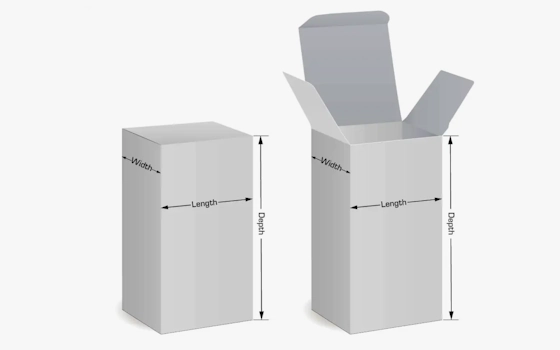
Measuring a box the right way is important for shipping, storage, and custom packaging. Accurate measurements help you choose the right packaging size, avoid extra shipping charges, and keep your products safe. Box dimensions always follow a standard order, so once you know the basics, the process becomes very simple.
In this blog, you’ll learn about the three dimensions of the box, how to measure them, and what to avoid.
The Three Dimensions of the Box
A box has three main dimensions: length, width, and height.
To measure them correctly:
- Length – This is the longest side of the box.
- Width – This is the shorter side next to the length.
- Height – This is how tall the box is from top to bottom.
When written, dimensions always follow the same format:
Length × Width × Height
Most packaging companies use internal dimensions to make sure products fit properly inside the box.
- If the box is tall or facing upward, the length and width will be smaller, and the depth will be the most noticeable dimension.
- In the case of long boxes, the depth and width will be smaller than the length.
Measuring Box Volume
Box volume helps you understand how much space is inside the box. This is useful for packing items, calculating storage capacity, and estimating shipping needs.
To find the volume, use this simple formula:
Volume = Length × Width × Height
For example:
If a box is 10″ × 6″ × 4″, its volume is 240 cubic inches.
This measurement tells you how much space is available inside the box, not how strong the box is or how much weight it can hold.
Issue of Measuring External Dimensions
Many people get confused between inside and outside measurements.
Here’s why it matters:
- Internal dimensions show how much space you can fill.
- External dimensions include the thickness of the material.
If you measure outside dimensions, you may choose a box that looks right but is too small inside. Also, if you measure only the outside of the box, your product may not fit the way you expect. For shipping, carriers often use external dimensions to calculate dimensional weight, which can affect shipping costs.
Always check what your supplier or courier requires so you can avoid mistakes and extra fees.
Conclusion
Measuring a box becomes simple when you know its three main dimensions: length, width, and height. It also helps to understand the difference between internal and external measurements. Accurate measurements ensure proper fit, better protection, and cost-effective shipping. Use the standard order and measurement tips to choose the right box every time.
