


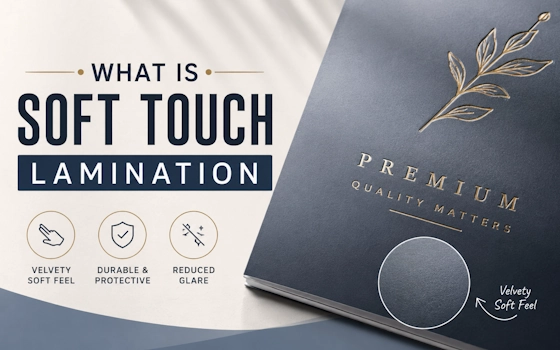
Soft touch lamination is a finishing process. It applies a thin protective film to a printed surface. It creates a smooth and velvety feel that differentiates the surface from traditional matte and gloss lamination. The finish has a low shine and is often used on product boxes, business cards, brochures, book covers and other printed materials. This guide explains what soft touch lamination is, how it works, its benefits, common uses and how it compares with other lamination finishes.
Understanding Soft Touch Lamination
Soft touch lamination is a finishing process in which a thin layer of biaxially oriented polypropylene (BOPP) film is applied to a printed surface. The film has a smooth and velvet-like texture. It feels softer than standard matte or gloss finishes. During production, the film bonds to the printed material through controlled pressure or heat. Once applied, it creates a protective layer over the print.
It is available in a low shine finish. So it reduces the strong reflections that are commonly seen in glossy surfaces. Its muted appearance works well for simple and luxury packaging designs.
What Is the Process of Soft Touch Lamination?
Soft touch lamination is applied after the artwork has been printed. The exact process depends on the equipment and material. But it generally follows these steps:
- First, the packaging artwork is finalized according to the required size, layout and printing specifications.
- The design is then printed onto the selected packaging materials. Such as all text, graphics, logo and other artwork.
- The printed sheets are inspected and prepared to make sure the surface is ready for lamination.
- A thin layer of soft touch film is carefully applied over the printed surface.
- Controlled heat, pressure or adhesive is used to bond the film securely to the material.
- The laminated sheets are allowed to cool and settle so the film can bond properly.
- Any excess film is trimmed from the edges before the sheets move to the next production stage.
- The finished surface is inspected for bubbles, wrinkles, scratches, uneven areas and other defects.
After lamination, the sheets can move through the remaining packaging production stages. Such as cutting, creasing, folding and gluing.
What are the Benefits of Soft Touch Lamination?
Soft touch lamination provides many benefits. It provides a luxurious feel and low shine effect. Some popular benefits are:
Creates a Velvety Surface
Soft touch film gives the printed surface a smooth and velvety feel. This creates a clear difference between laminated and unlaminated surfaces. The texture can also make the package more premium to hold. It also improves the overall buying experience.
Gives Packaging a Matte Appearance
The surface has little shine as compared to gloss lamination. This makes colors look softer and reduces strong reflections from light. It can work well with minimal packaging designs, dark color palettes, neutral shades and simple branding.
Adds Surface Protection
Lamination creates a protective layer on the printed surface. It can help to protect the print from normal handling, light scuffing, moisture exposure and everyday wear. The level of protection depends on the film, material and production quality.
Reduce Visible Fingerprints
A soft touch finish can make fingerprints and smudges less noticeable. This can be useful for packaging that customers frequently pick up, open and display.
Improves Handling
The soft surface of a soft touch finish has a different grip than a smooth glossy finish. It works well for glass, metal and plastic containers.
What Are the Different Types of Soft Touch Lamination?
Soft touch lamination comes in different forms. Each type offers specific surface properties for different applications. Here are the different types:
Polyurethane (PU)
Polyurethane is the most common type of soft touch lamination, which is known for its smooth and velvety feel. It is available in different thicknesses and can provide a matte appearance. It is suitable for printed materials that need a soft finish.
PET Polyester
PET polyester provides a smooth appearance and soft feel similar to other soft touch films. It offers good dimensional stability. It is also an economical option for applications that require less durability.
Anti-Slip
Anti-slip lamination has a lightly textured surface. It provides a better grip for products that are handled often. The textured surface prevents slipping.
Scratch-Resistant
Scratch-resistant lamination is designed to provide better protection against everyday scratches, scuffs and abrasion. It is suitable for products that experience frequent handling. Such as electronic packaging and cases.
Comparison Between Soft Touch Lamination and Matte Lamination
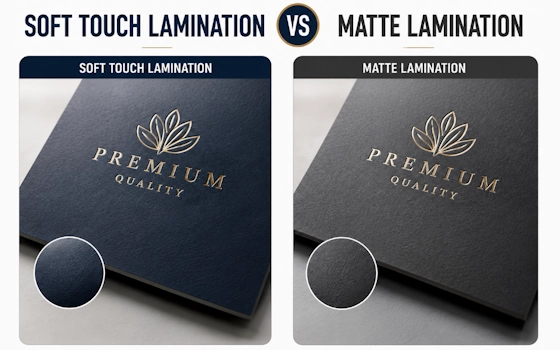
Soft touch and matte lamination are similar because both reduce surface shine. The main difference is the feel of the finished surface. Here is an easy comparison for better understanding:
| Features | Soft Touch Lamination | Matte Lamination |
| Appearance | Low shine and velvety look | Low shine and flat, but have no velvety feel |
| Feel | Soft and smooth | Smooth |
| Tactile effect | Stronger | More subtle |
| Cost | Higher | Lower |
| Common use | Premium packaging | General printed packaging |
Choose soft touch when the feel of the packaging is important. But matte lamination is a better option when you want a non-glossy appearance at a lower cost.
Conclusion
Soft touch lamination adds a smooth and velvety surface to printed materials. It provides a low shine and adds a layer of surface protection. It is a practical choice for packaging, business cards, brochures, book covers and other products where texture and appearance are important. Choosing the right type of soft touch lamination depends on your product and its use. You can also pair it with suitable printing to get the look and feel you want.
